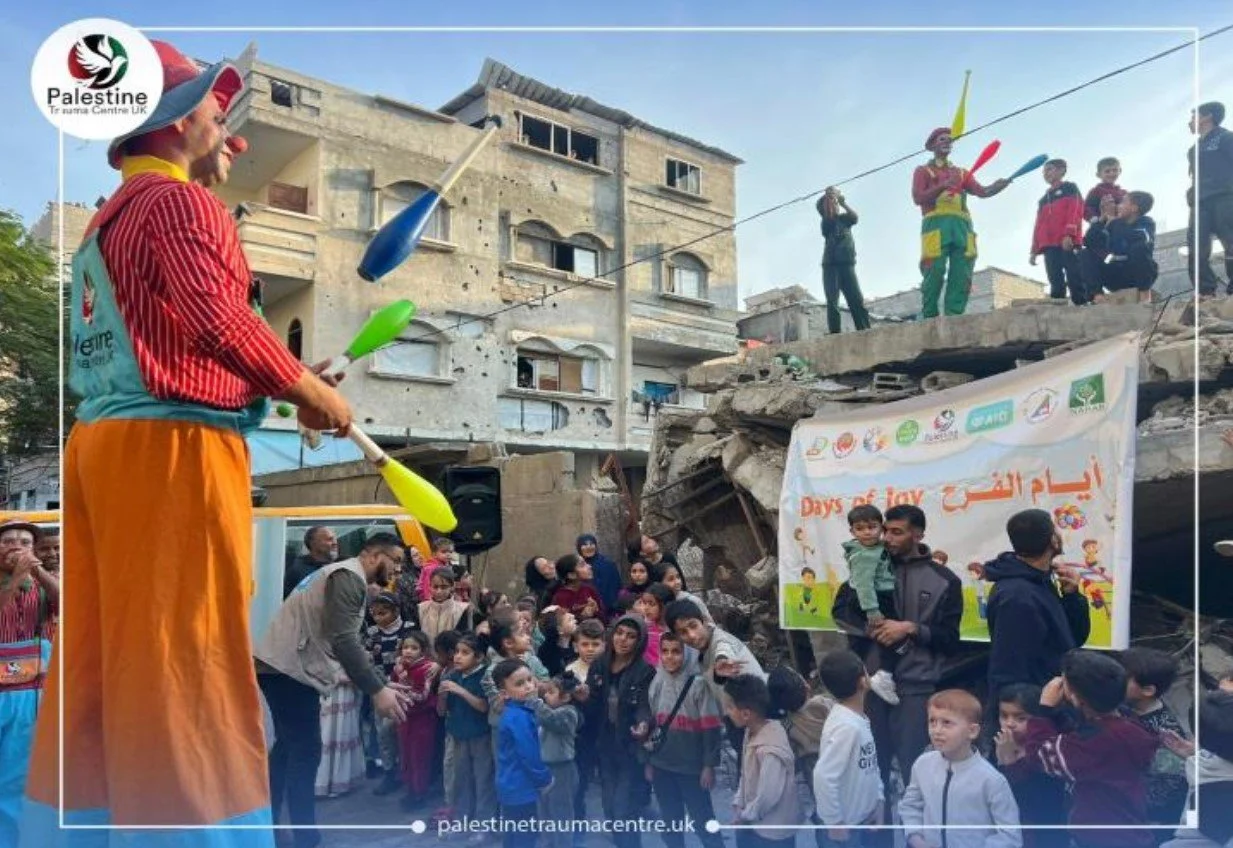
Our latest “Talk to Gaza” on 13th December 2025 was affected by the terrible winter storm that hit the region. Despite hazards many of the team travelled to find internet connection to reach us. This account, “Standing on the Stairs”, reveals their state of chronic uncertainty and their efforts to regain some normality in an abnormal environment.
Download: PDF Transcript (337 KB)
52 attended this meeting and members of the Days of Joy team travelled to the PTC(UK) centre to join in. Eman’s home had been flooded by the storm and she could not come. Omar, Samar, Mahmoud, Bayn, Aloosh, Yehia, Ahmed G, Morad and Niveen spoke to us, reflecting particularly on the devastation caused by the storm. One neighbour had been killed when the wall of his home, built on sand and weakened by floodwater, collapsed on him.
Life in Gaza since the so-called ceasefire was slightly calmer. Food was available, but very expensive. There is no cash. Owners of supermarkets want cash but have to put up with transactions on internet banking. There is still not enough aid, and its distribution is very inefficient. What gets in are not essential items like eggs and meat, but stuff for trade No equipment is available to repair infrastructure. Roads are difficult to keep open. One has to walk over rubble to reach many places. What used to take half an hour now takes 2 to 3 hours.
The Israeli army is closer than before, occupying over 50% of Gaza.
Populations are squeezed into smaller and smaller areas. The trauma centre has no roof. The team used to work on the top floor of the building but have now moved to a ground floor space a few metres away. They still support children and are gradually reviving activity sessions. Mahmoud stressed the importance of working regularly in spite of the destruction. Aloosh reminded us that everyone had lost family, friends and homes. The health sector has not recovered and essential medicines for chronic conditions are not available.
School buildings that remain are used to house displaced families. Most children have missed a whole year of schooling.
After the ceasefire a determined effort was made to establish some regular education, whether in tents or bombed buildings. Many small schools started up. Many have no chairs and the children sit on blankets.
Most attend for part of a day and classes are organised in shifts. It is seen as vitally important for children to “keep the educational mood”, as Dr Omar put it. The children must revive the school habit even if it is at odd times and infrequent. This has mental health benefits as well as being an important cultural feature of Palestinian life. There is a lot of studying online.
Lecturers deliver courses from Turkey, Egypt and other places. Yehya’s son recently graduated. He studied Psychology in order to work on trauma therapy for disabled children.
Many in the team expressed gratitude for the contact they were having with us now. The knowledge that we are still actively in solidarity with them helps sustain their morale as the horrors continue and most leaders in the region and across the world offer nothing but betrayal.